01 — System layout
How wastewater leaves a Pueblo property
Inside a building, fixture drains connect to branch piping and then to the building drain. The building sewer or service lateral continues underground from the structure toward the public sewer connection. The connection to the City sewer main is commonly called the sewer tap.
The public main collects wastewater from many properties and carries it through the municipal collection system for treatment. A problem affecting only one property often lies in a fixture, branch, building drain, private lateral, or private tap. A broader public-main problem can affect multiple properties, but the symptoms alone do not establish ownership.
02 — Ownership
Who maintains the private sewer line in Pueblo?
The City of Pueblo's sewer FAQ states that the home or business owner owns both the sewer service line and the sewer tap and is responsible for their maintenance and repair. Because boundaries and circumstances can vary, confirm responsibility with the City and review property documents before major work.
Ownership affects who authorizes inspection, pays for excavation, coordinates work in a right-of-way, and restores disturbed surfaces. If the suspected defect is near the main or within a street, do not assume it is automatically a City repair.
Local source: City of Pueblo sewer service FAQ ↗
03 — Pipe materials
Materials found in older and newer sewer laterals
The material can influence likely defects and repair choices. Older systems may include clay tile, cast iron, Orangeburg or other bituminous fiber pipe, or early plastic. Newer replacements commonly use PVC or another approved plastic piping system. The actual material should be verified by records, cleanout observation, or camera inspection.
04 — Failure causes
Why underground sewer lines develop problems
Root intrusion
Roots seek moisture and can enter through small openings at joints, cracks, or damaged connections. Cutting roots restores space in the pipe, but the opening remains unless repaired. Root recurrence is therefore a condition question as well as a maintenance question.
Offsets and separated joints
Pipe sections can move out of alignment because of settlement, poor support, soil movement, or installation defects. An offset can catch paper and waste, admit soil or roots, and restrict camera travel.
Bellies and improper slope
A belly is a low section where water stands. The depth, length, and percentage of the pipe affected influence severity. Lining generally follows the existing shape and does not automatically correct slope.
Corrosion, scaling, and material deterioration
Cast iron can develop internal buildup or wall loss. Fiber pipe can deform. Clay can fracture. The extent of deterioration determines whether cleaning, spot repair, lining, or replacement is realistic.
Foreign material and misuse
Grease, wipes, hygiene products, construction debris, and other materials can obstruct the line even when the pipe is structurally intact. Repeated blockages in the same location still warrant investigation.
05 — Diagnosis
How symptoms become a defensible repair scope
A defensible evaluation typically moves from symptoms to access, cleaning if necessary, camera inspection, locating, and method selection. Skipping diagnosis can result in a quote that addresses the wrong location or assumes a repair method before the pipe is understood.
- Map the symptoms.Identify every affected fixture, the lowest point of overflow, timing, and whether the problem changes with water use.
- Find access.Locate interior or exterior cleanouts and determine whether the complete building sewer can be reached.
- Restore visibility.A blocked line may need cabling or jetting before a camera can view the wall.
- Record the condition.Document pipe material, defects, standing water, connections, and how far the camera traveled.
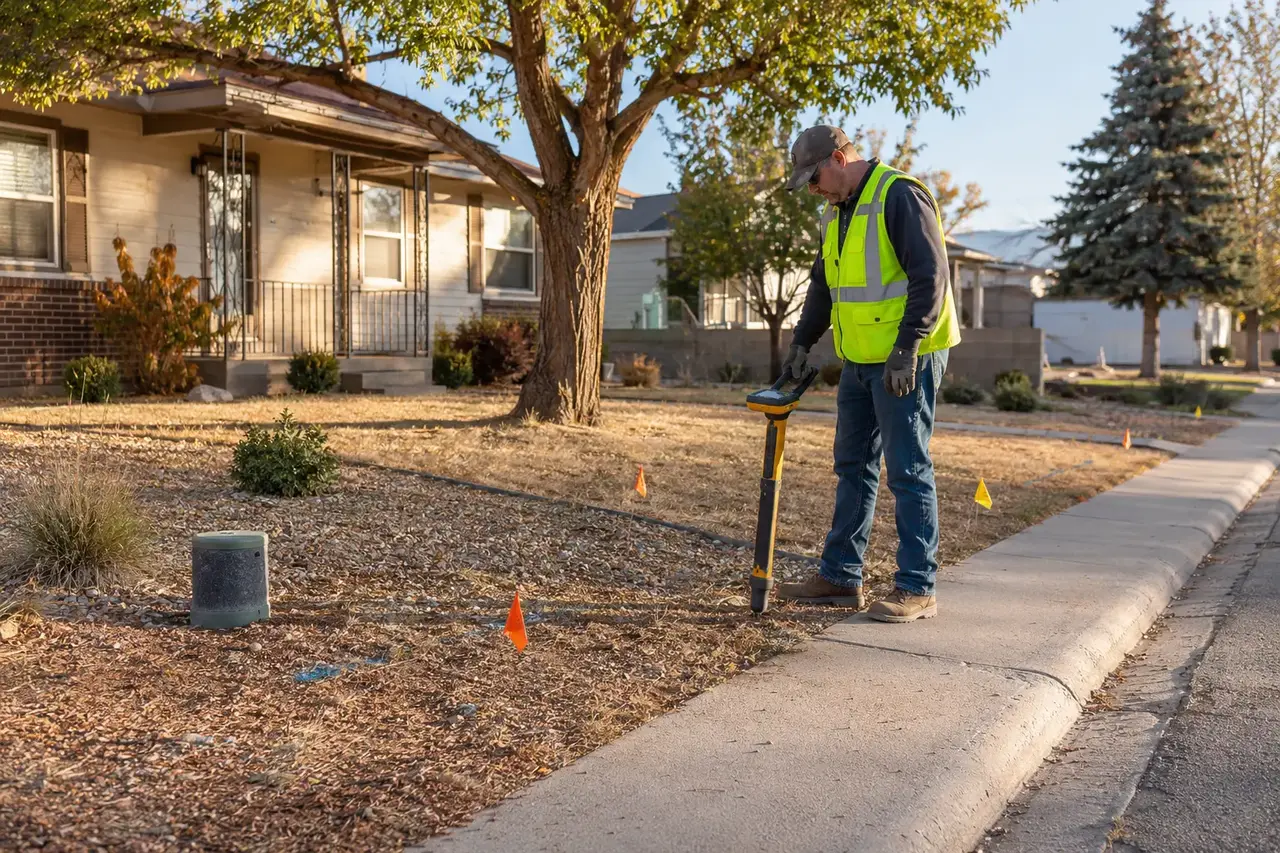
- Locate the defect.Use a transmitter and surface receiver to estimate the route and depth.
- Compare methods.Evaluate targeted excavation, lining, pipe bursting, partial replacement, or full replacement against actual conditions.
06 — Sewer or septic
Not every Pueblo County property connects to city sewer
Pueblo County describes an on-site wastewater treatment system as a self-contained underground wastewater treatment system commonly used in rural areas. A septic-connected property still has a building sewer, but that pipe leads to the treatment tank rather than a municipal main.
Slow drains or backups on a septic property can involve the building sewer, an inlet or outlet component, the tank, effluent piping, or the soil treatment area. Pumping the tank does not repair a broken building sewer, and clearing the building sewer does not correct a failed absorption system.
Local source: Pueblo County on-site wastewater information ↗
07 — Planning work
What a complete sewer proposal should explain
Each proposal should identify the line segment, depth, method, new material, cleanouts, permits, inspection, testing, backfill, surface restoration, exclusions, warranty, and change-order process. A short quote may be easy to read but difficult to compare.
- Where does the work begin and end?
- What did the camera show, and is the recording included?
- Why is this method suitable for the observed defect?
- Will the work change slope or only restore structural integrity?
- Who handles utility marking, permits, traffic control, and inspections?
- Are concrete, asphalt, irrigation, fencing, and landscaping restored?
- What hidden conditions could change the price?
- What does the warranty cover and exclude?
08 — Prevention
Records and habits that reduce future uncertainty
Keep camera videos, locator marks, invoices, permit records, photographs, repair dimensions, pipe material, cleanout locations, and warranties. These records can shorten future diagnosis and help a buyer understand completed work.
Avoid flushing wipes and hygiene products, manage grease properly, protect cleanouts from damage, and respond to recurring symptoms instead of treating every event as an unrelated clog. Prevention cannot stop every pipe defect, but it can reduce avoidable blockages and improve decision-making.